Bergamo, in northern Italy, is a place where history is alive. It’s divided into two parts: Città Alta (Upper City) and Città Bassa (Lower City). Each part has its own story of cultural heritage.
Città Alta Bergamo is like a medieval treasure chest. It has ancient walls and buildings that take you back in time. Places like the Campanone and the Venetian Walls show how history and today blend together.
For those who love history and culture, Bergamo is the perfect spot. Its beauty and history make it a place where memories are made.
Key Takeaways
- Discover two distinct urban landscapes: Città Alta and Città Bassa
- Explore UNESCO World Heritage Venetian Walls spanning 6 kilometers
- Experience medieval architecture and rich cultural heritage
- Witness historic sites dating back to the 13th century
- Immerse yourself in a city where history comes alive
The Allure of Bergamo’s History
Bergamo is in the heart of Lombardy, showing Italy’s rich culture. This city tells a story of history that goes back thousands of years. It fascinates both travelers and historians.
The history of Bergamo’s sites starts with the Romans in 49 BC. Its location at the Alps’ foothills made it a key spot for different cultures. This shaped its unique look and buildings.
Introduction to Bergamo’s Historical Landscape
Bergamo’s history is filled with big changes, especially during the Venetian Republic. Its location was key for trade between Venice and Milan.
- Established as a Roman municipality in 49 BC
- Significant frontier town during the Venetian Republic
- Strategic location at the Alps’ foothills
Significance of Bergamo’s Historic Sites
The Venetian Walls of Bergamo are a top example of the city’s defense. They are a UNESCO World Heritage Site. These walls are over 6 kilometers long, with 14 bastions and 4 gates.
Bergamo’s sites show the medieval Città Alta and the modern Città Bassa. They take you through time, from Roman times to the Renaissance. Each place has its own story of growth and change.
Bergamo: Where every cobblestone whispers centuries of history
- UNESCO World Heritage Venetian Walls
- 14 bastions and 4 monumental gates
- 6 kilometers of historical fortifications
Bergamo’s history goes beyond its walls. In 1860, it gave the most volunteers to Garibaldi’s army. This made it known as “City of the Thousand.” It shows the city’s bravery and unity.
The Città Alta: A Journey Through Time
High above Bergamo, Città Alta is a breathtaking sight. It’s a window into Italy’s rich history. Travelers can explore a world of medieval and Renaissance architecture that’s remarkably well-preserved.
In the Lombardy region, Città Alta Bergamo is a true architectural treasure. Its high position offers amazing views of the landscape. It’s a place that fascinates history lovers and cultural explorers alike.
Overview of the Historic Elevated City
The Città Alta boasts four historical gateways that have withstood time:
- Porta Sant’Agostino (built in 1575)
- Porta San Giacomo (constructed in 1592)
- Porta San Lorenzo (established in 1627)
- Porta Sant’Alessandro (from the late 1500s)
Key Historical Landmarks
At the heart of Città Alta is the Piazza Vecchia Bergamo. It’s a square surrounded by medieval and Renaissance buildings. The Campanone bell tower, from the 12th Century, still rings 100 times at 10 PM. This tradition has lasted over 360 years.
“Walking through Città Alta is like traversing centuries of human history, with every stone telling a story of conquest, culture, and resilience.”
Visiting Tips for Città Alta
Visitors can easily get to Città Alta by funicular. It connects Città Bassa and Città Alta for over 120 years. Spring and early autumn are the best times to visit. The weather is mild, and there are fewer crowds.
- Wear comfortable walking shoes
- Bring a camera to capture stunning views
- Plan for at least half a day of exploration
- Consider guided walking tours for deeper historical insights
The Unmissable Basilica di Santa Maria Maggiore
In the heart of Bergamo, the Basilica di Santa Maria Maggiore is a stunning sight. Founded in 1133, it has seen many changes over the years. Today, it’s a shining example of Italian church architecture.
Historical Significance
The Basilica di Santa Maria Maggiore was built during Bergamo’s tough times. It was a beacon of hope during droughts, plagues, and famines. It shows the strength and spirit of medieval Bergamo.
- Founded in 1133
- Survived over 900 years of historical transformations
- Symbolizes community strength and architectural innovation
Architectural Features
The basilica’s design is a marvel. Its façade is made of white and pink marble, creating a beautiful contrast. It has four side doors, a unique feature of medieval architecture.
Must-See Interior Highlights
Inside, the Basilica di Santa Maria Maggiore is a feast for the eyes. The Cappella Colleoni is a Renaissance masterpiece. It’s filled with intricate details, tapestries, and stucco work, offering a cultural experience like no other.
| Visitor Information | Hours |
|---|---|
| Sunday | 09:00 am – 06:00 pm |
| Monday – Friday | 09:00 am – 12:30 pm, 02:30 pm – 06:00 pm |
| Saturday | 09:00 am – 06:00 pm |
Visiting Bergamo without seeing the Basilica di Santa Maria Maggiore is missing out. Its history, architecture, and cultural importance make it a must-see for anyone interested in Italian heritage.
Palazzo della Ragione: A Glimpse into Civic Life
In the heart of Piazza Vecchia, the Palazzo della Ragione shines. It’s a key part of Bergamo’s history. This building gives us a peek into the city’s medieval life.
The Palazzo dates back to the 12th century. It was the heart of city government. Its spot in Piazza Vecchia shows its big role in the city.
Historical Significance
The palazzo has seen many changes over the years. Some important moments include:
- It was the main place for city government.
- It was where court cases were held back then.
- It shows how architecture changed from medieval to Renaissance times.
Architectural Highlights
People who love buildings will love the palazzo’s design:
- It has Gothic and Romanesque styles.
- The stone work is very detailed.
- The arched windows show great craftsmanship.
Visitor Experience
Visiting Bergamo’s historic sites? Don’t miss the Palazzo della Ragione. Guided tours let you see old rooms, frescoes, and learn about its role in Bergamo’s history.
“Walking through Palazzo della Ragione is like stepping into the living history of Bergamo” – Local Historian
The palazzo is in beautiful Piazza Vecchia. It’s a top spot for anyone wanting to dive into Bergamo’s culture.
The Enigmatic Carrara Academy of Fine Arts
In the heart of Bergamo, the Accademia Carrara Art Gallery shines. It’s a key part of Bergamo’s rich art history. Here, visitors can explore centuries of artistic greatness.
The gallery boasts 1,793 paintings from the Renaissance to the late 19th century. Fans of art can see works by Botticelli, Raphael, and Titian. Each piece shares its own story of creativity.
Role in Bergamo’s Art Scene
The Accademia Carrara is a vital part of Bergamo’s culture. It keeps art alive by linking old traditions with new ideas.
Noteworthy Artworks and Artists
- Recent exhibition “Cecco del Caravaggio. The Model Pupil” featured 19 rare works
- International loans from museums in Berlin, London, Madrid, and other major cities
- Comprehensive collection showcasing diverse artistic styles and techniques
Special Exhibitions to Check Out
The gallery often hosts innovative exhibitions. These shows give a deep look into art history. For example, the Cecco del Caravaggio show showed the museum’s dedication to research and sharing knowledge.
A treasure trove of artistic brilliance waiting to be discovered in the heart of Bergamo.
Fortifications of Bergamo: A Defensive Marvel
The Venetian Walls of Bergamo are a stunning example of the city’s defensive past. Built by the Republic of Venice in 1561, they stretch for 5 kilometers. They surround the historic center, showing Bergamo’s strategic value. Explore the Bergamo Historic Sites to learn about these amazing walls.

The Venetian Walls of Bergamo are more than a military site. They were named a UNESCO World Heritage Site in 2017. They show off their historical and architectural importance. Visitors can see the walls’ detailed design from different angles.
- Four strategic gates punctuate the walls’ perimeter
- Panoramic walking paths offering stunning city views
- Well-preserved 16th-century fortification techniques
Historical Context of the Fortifications
The walls were built during a key time in Venetian military engineering. Bergamo’s strategic location made it vital for the Venetian Republic. The walls not only defended the city but also showed off the advanced urban planning of the time.
Walking Tours of the Fortifications
“Walking these walls is like stepping back in time, experiencing the architectural brilliance of 16th-century defensive strategies.” – Local Bergamo Historian
Guided walking tours now let visitors explore these amazing sites. They can follow the 5-kilometer route, learning about the walls’ history and the city’s military past.
| Fortification Details | Specifications |
|---|---|
| Construction Year | 1561 |
| Total Length | 5 kilometers |
| Number of Gates | 4 |
| UNESCO Recognition | 2017 |
The Renaissance and Its Impact on Bergamo
Bergamo’s historic sites show a stunning Renaissance legacy. This period of artistic innovation made Bergamo a hub of creativity and learning.
The Renaissance changed Bergamo’s art and buildings in amazing ways. It brought forward leaders who shaped the city’s culture for years to come.
Key Renaissance Figures
- Lorenzo Lotto: A famous painter who made big contributions
- Mauro Codussi: An architect who changed city design
- Giovanni Battista Moroni: A skilled portrait artist
Lasting Influence on Architecture
The Cappella Colleoni is a stunning example of Renaissance architecture. It shows the era’s focus on beauty and detail.
Artworks of the Renaissance Era
Bergamo’s museums and churches have amazing Renaissance art. The Accademia Carrara, for example, has fifteen beautiful Italian paintings that show the era’s spirit.
The Renaissance in Bergamo was not just an artistic movement, but a profound cultural transformation.
New techniques appeared during this time. Artists like Vincenzo Foppa and Bergognone created new styles. The invention of movable type in Venice in 1469 also helped spread Renaissance ideas, making books on art and architecture more available.
Exploring Minor yet Significant Historical Sites
Bergamo Historic Sites are more than famous landmarks. They have hidden stories of culture and architecture. Visitors can find gems that show Bergamo’s rich history.
San Vigilio Castle: A Panoramic Treasure
The Rocca di Bergamo sits high above Bergamo, offering amazing views. You can get there by a scenic funicular from Città Alta. It’s an adventure itself. The castle was key in defending the area.
- Stunning panoramic views of Bergamo and surrounding valleys
- Accessible by historic funicular railway
- Significant historical defensive position
The Church of San Bartolomeo: A Hidden Architectural Gem
In Bergamo’s heart, the Church of San Bartolomeo is a local architectural treasure. Its detailed design and history make it a key spot for those interested in Bergamo’s past.
| Feature | Details |
|---|---|
| Architectural Style | Baroque with Renaissance influences |
| Historical Period | 15th-16th century |
| Notable Artwork | Historic religious frescoes |
Monument to the Fallen: Remembering Local Heroes
The Monument to the Fallen honors local heroes who gave their lives. It’s in a key spot, reminding us of Bergamo’s history and bravery.
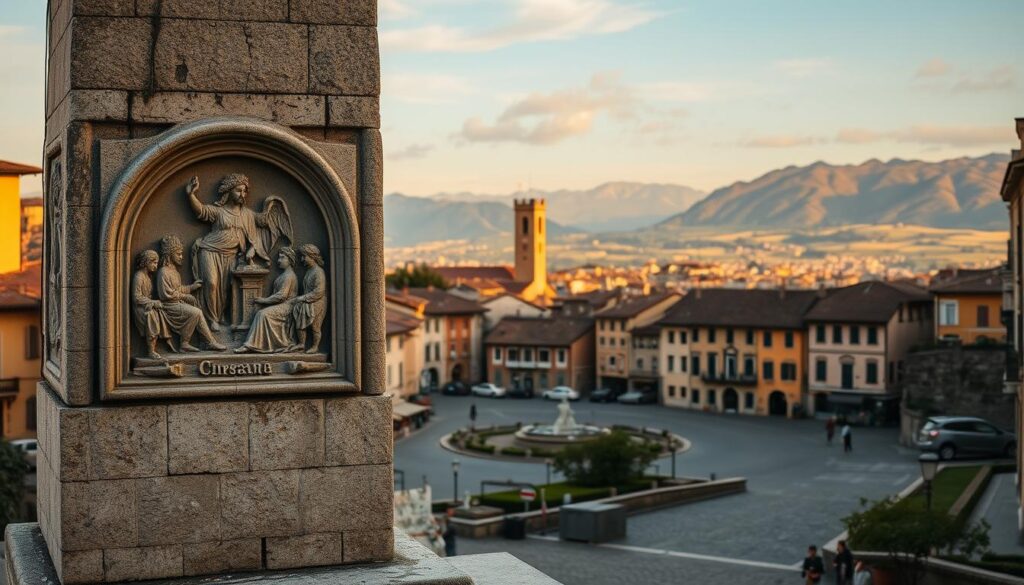
These sites show Bergamo’s rich history. Each location has its own story. They invite travelers to explore and connect with Bergamo’s deep culture.
Cultural Events Celebrating Bergamo’s Heritage
Bergamo is alive with culture, celebrating its history through festivals, art, and food. Its historic sites are the perfect setting for these events. They connect the past with the present, offering a true taste of Bergamo’s spirit.
Annual Festivals that Showcase Local Traditions
Every year, Bergamo shines with festivals that show off its culture. Some top events include:
- Fiera di Sant’ Alessandro (January): Celebrating the city’s patron saint
- Bergamo Jazz Festival (April): Featuring local and international musicians
- Fiera del Libro (May): A literary celebration with diverse works and seminars
- Bergamo Jazz Festival: Welcoming renowned artists like Danilo Pérez
Art and Cultural Programs
Bergamo’s culture is enhanced by its art institutions. GAMeC, founded in 1991, features works by famous artists like Picasso and Boccioni. The Bergamo Cathedral and other historic sites offer unique spaces for art.
| Cultural Institution | Notable Features |
|---|---|
| GAMeC | Modern art museum with international collections |
| Carrara Academy | 4-floor gallery with medieval to 19th-century artworks |
| Cathedral Museum | Displays Roman and early Christian artifacts |
Local Culinary Events Tied to History
Bergamo’s food traditions are celebrated in special events. The Moscato wine festival in Scanzorosciate and the winter Christmas markets in Piazza Dante highlight local flavors. They connect visitors with Bergamo’s culinary heritage.
With over 500 artists at events like the Donizetti by Night festival, Bergamo is a vibrant cultural spot. It honors its history while embracing new creativity.
Practical Tips for Visiting Bergamo’s Historic Sites
Planning a trip to Bergamo’s historic sites needs careful thought. Travelers aiming for a memorable visit to Città Alta Bergamo should consider a few key points. The city’s layout and transport options make exploring both fun and easy.
Getting around Bergamo’s historic areas is crucial. The famous funicular railway, in use since 1887, links Città Bassa and Città Alta with breathtaking views. A one-way ticket costs €1.70 and is valid for 75 minutes. This makes it a cheap and scenic way to travel. Public transport also helps, with a 24-hour ticket for all transport costing €8.50.
When to visit Bergamo Historic Sites can greatly improve your experience. Summer brings lively festivals like the Festa di Sant’Alessandro. Spring and autumn have mild weather perfect for walking the UNESCO-designated Venetian Walls. Visiting during these seasons can save money and avoid crowds.
For the best experience, plan a 2-day trip to see top spots like the Accademia Carrara, Basilica di Santa Maria Maggiore, and the Campanone tower. With good planning and these tips, visitors can dive deep into Bergamo’s history while having a comfortable and memorable trip.