Nestled in Lombardy, northern Italy, Mantua stands as a captivating hidden gem. This ancient city offers a serene escape from crowded tourist trails. Its Renaissance splendor blends seamlessly with authentic Italian charm.
Mantua’s credentials are impressive. In 2008, its historic center earned the prestigious designation as a UNESCO World Heritage Site. This recognition highlights its exceptional cultural and architectural significance. The city was also named Italy’s Capital of Culture in 2016.
The city‘s unique geography adds to its magic. It is surrounded by three shimmering artificial lakes. These lakes create a romantic, waterside atmosphere. They were originally built in the 12th century for defense.
Visitors discover a remarkable concentration of art and history here. They can experience world-class Renaissance masterpieces without the crowds of Florence. The compact size means top sights are within easy walking distance.
This guide provides insider knowledge on the most rewarding places to explore. From grand palaces to intimate churches, Mantua tells a story spanning four millennia. It is a destination for travelers seeking deep, meaningful culture.
Key Takeaways
- Mantua is a UNESCO World Heritage Site recognized for its outstanding cultural value.
- The city is uniquely surrounded by three artificial lakes, creating a distinctive setting.
- It offers a rich Renaissance art and architecture experience without large crowds.
- Mantua has been honored as both the Italian Capital of Culture and European Capital of Gastronomy.
- Its compact, walkable center makes exploring its many attractions efficient and enjoyable.
- The city boasts a history that dates back thousands of years.
Discover the Rich History and Culture of Mantua
With roots reaching back to 2000 BC, Mantua presents a living timeline of European civilization and artistic achievement. This ancient settlement’s remarkable 4,000-year history unfolds through successive civilizations that each left their mark.
Origins and Historical Significance
The Etruscans established presence here in the 6th century BC, followed by Roman occupation. Visitors can witness this layered history through archaeological treasures like the ancient mosaics beneath Piazza Sordello.
These tangible connections to early Western culture make Mantua’s historical significance undeniable. The Roman poet Virgil, born nearby, adds literary prestige to the city’s credentials.
The Legacy of the Gonzaga Family
From the 14th to early 18th century, the Gonzaga family transformed Mantua into a Renaissance capital. Their nearly four-century rule marked the city’s golden age of cultural achievement.
The Gonzaga family’s patronage attracted legendary artists and architects to their court. They viewed artistic excellence as an expression of political power, creating a concentration of masterpieces that rivals Florence.
| Historical Period | Time Frame | Key Characteristics | Lasting Legacy |
|---|---|---|---|
| Etruscan Settlement | 6th Century BC | Early urban development | Foundation layers |
| Roman Occupation | 3rd Century BC onward | Strategic military position | Virgil’s birthplace |
| Gonzaga Rule | 1328-1708 | Renaissance patronage | Architectural masterpieces |
| UNESCO Recognition | 2008 | World Heritage status | Preserved urban planning |
This rich context earned Mantua’s historic center UNESCO World Heritage status in 2008. Understanding this deep history transforms sightseeing into an immersive journey through centuries of cultural refinement.
The Iconic Ducal Palace – A Renaissance Masterpiece
Dominating Mantua’s skyline, the Ducal Palace stands as a monumental testament to Renaissance power and artistry. This sprawling palazzo ducale is not merely a building but an entire district within the city, featuring over 1,000 rooms across 35,000 square meters.
Its magnificent architecture includes courtyards, gardens, and elaborate passageways. They reveal the extraordinary wealth of the Gonzaga family.
Explore the Camera degli Sposi and Frescoes
The undisputed highlight is the Camera degli Sposi. Here, the artist Andrea Mantegna created revolutionary frescoes that cover every surface.
His famous trompe-l’oeil ceiling creates an illusion of an open sky. Figures appear to peer down, a groundbreaking technique for its time. This chamber is a masterwork of Renaissance art.
Uncover Castello di San Giorgio
Within the complex lies the imposing Castello di San Giorgio. This 14th-century moated castle adds a medieval layer to the palazzo ducale experience. It later became a refined residence.
Other remarkable rooms include the Hall of Pisanello. Isabella d’Este’s apartments also showcase exquisite treasures.
Visitors should allocate several hours for exploration. A guided tour is highly recommended to fully appreciate the history. The ducal palace is open Tuesday to Sunday from 8:15 AM to 7:15 PM.
Te Palace: A Journey Through Art and Architecture
Designed by Giulio Romano, Raphael’s most talented pupil, Palazzo Te showcases the revolutionary Mannerist style that challenged classical conventions. This 16th-century masterpiece served as a pleasure palace for Federico II Gonzaga, blending palace grandeur with villa intimacy.
Marvel at Extravagant Frescoes
Nearly every surface within this architectural wonder features breathtaking frescoes. The Room of Psyche presents the mythological love story of Eros and Psyche across its walls and ceiling.
Giulio Romano’s artistic vision transforms each chamber into a narrative experience. The Hall of Horses displays life-size equine portraits that showcase Renaissance attention to detail.
The Intriguing Chamber of the Giants
The Sala dei Giganti represents one of Mannerism’s most ambitious experiments. Romano created an immersive 360-degree fresco depicting the fall of giants from Ovid’s Metamorphoses.
This room eliminates traditional architectural divisions between walls and ceiling. Visitors feel engulfed by the dramatic celestial punishment scene.
| Feature | Location | Artistic Significance | Visitor Experience |
|---|---|---|---|
| Room of Psyche | Banquet Hall | Mythological narrative frescoes | Vivid storytelling immersion |
| Chamber of Giants | Central wing | Mannerist perspective innovation | 360-degree artistic envelopment |
| Hall of Horses | Ground floor | Life-size equine portraiture | Renaissance realism appreciation |
| Secret Garden | Exterior grounds | Architectural-landscape integration | Peaceful aesthetic continuation |
Exploring this palace requires approximately two hours. The seasonal schedule accommodates visitors throughout the year with extended summer hours.
Wandering the Streets: Embrace the Local Charm
Stepping into Piazza Sordello feels like walking through layers of Mantua’s living history. This ancient square serves as the historic and spiritual heart of the city, where Etruscan and Roman civilizations once thrived.
Piazza Sordello and the Vibrant Cityscape
The square showcases an impressive architectural ensemble. Visitors find themselves surrounded by significant buildings including palaces and the cathedral. This creates an outdoor museum showcasing styles from Romanesque to Renaissance.
Look for the visible Roman mosaic fragment in the southwest corner. This rare artifact connects you directly to Mantua’s classical past. It remains in its original location rather than behind museum glass.
The Torre della Gabbia stands as a reminder of medieval justice. Its hanging cage once held prisoners for months, even for minor infractions like pickpocketing. The iron cell remains suspended today.
Visit Piazza Sordello at different times to observe changing light on the facades. Watch how locals use this space against centuries-old architecture. The square makes an ideal starting point for exploring Mantua’s historic center.
Wander beyond the main place to discover hidden courtyards and artisan workshops. The town rewards travelers who take time to absorb its tranquil atmosphere. Engage with friendly locals and appreciate how history integrates into everyday life.
Religious Landmarks: Basilica di Sant’Andrea and More
Mantua’s spiritual landscape reveals itself through remarkable religious architecture that has withstood centuries. These sacred spaces serve as both active places of worship and open-air museums of Renaissance art.
The magnificent Basilica di Sant’Andrea dominates as the city’s most significant church. Designed by Leon Battista Alberti in the 15th century, this Renaissance masterpiece houses Christianity’s extraordinary relic—the Precious Blood of Christ.
“The basilica represents a perfect synthesis of architectural theory and spiritual practice.”
The Unique Features of Rotonda di San Lorenzo
Rotonda San Lorenzo stands as Mantua’s oldest church, dating to the 11th century. Its unique circular design creates an intimate spiritual atmosphere. Recent restoration removed centuries of additions, revealing the original Romanesque structure.
Though most frescoes have been lost, fragments remain near the dome. This ancient place likely marks where Christ’s blood was hidden and rediscovered.
Mantua Cathedral: Art and Architecture Combined
The Cathedral of San Pietro showcases layered architectural styles from Romanesque to Baroque. Giulio Romano’s interior redesign creates a harmonious blend of historical periods.
Nearby in Piazza delle Erbe, the clock tower (Torre dell’Orologio) functions as both timepiece and scientific marvel. This 15th-century tower tracks planetary positions with sophisticated mechanisms.
| Landmark | Century | Key Feature | Visitor Highlight |
|---|---|---|---|
| Basilica di Sant’Andrea | 15th | Precious Blood relic | Mantegna chapel paintings |
| Rotonda San Lorenzo | 11th | Circular design | Free entry, ancient atmosphere |
| Mantua Cathedral | 14th-18th | Architectural fusion | Baroque marble facade |
| Clock Tower | 15th | Astronomical clock | Hourly bell ringing |
These religious landmarks offer profound glimpses into Mantua’s spiritual heritage. They remain essential stops for understanding the city’s cultural depth.
Unforgettable Experiences Around the Lakes
Mantua’s unique geography, defined by three man-made lakes, creates exceptional opportunities for outdoor recreation. These 12th-century engineering marvels originally served defensive purposes but now provide a romantic waterside setting.

The largest of the three, Lago Superiore, features stunning lotus flowers and graceful swans. This creates picturesque natural scenes just steps from the city‘s architectural grandeur.
Cycling and Walking the Mincio River Paths
The Mincio cycle path offers an outstanding way to explore the region. This scenic 44-kilometer route connects Mantua to Lake Garda through relatively flat terrain.
Cyclists of various ability levels can enjoy a full day of exploration. The path passes through small villages and agricultural landscapes. This reveals authentic regional character beyond major tourist destinations.
Renting a bike provides the perfect way to experience this route. The journey offers rewarding panoramic views of Lombardy’s countryside.
Scenic Sunset Views on the Artificial Lakes
Sunset viewing around the lakes creates an unmissable Mantua experience. Golden hour light transforms the water and illuminates the city‘s towers.
This time of day provides spectacular photographic opportunities. The calm waters reflect the changing colors of the sky.
Lakeside parks and greenspaces offer ideal locations for relaxation. Community gardens demonstrate how locals incorporate these historic waterways into daily life.
Spending time around the lakes provides essential balance to cultural sightseeing. It offers natural beauty and contemplative spaces for travelers.
Best Places to Visit in Mantua: Top Attractions
With proper preparation, even a single day in Mantua can provide a comprehensive cultural immersion and architectural appreciation. The city’s compact layout makes efficient exploration possible for time-conscious travelers.
Planning Your Perfect Day Trip
A well-structured itinerary maximizes your limited time. Begin your day at the Palazzo Ducale complex and surrounding Piazza Sordello area.
The afternoon should include religious landmarks and Palazzo Te. Conclude with an evening lakeside stroll and authentic dining experience.
Essential Practical Tips for Visitors
Mantua connects easily to other Italian cities by train. When booking, use “Mantova” for accurate search results.
Travelers arriving by car will find convenient parking options. Free spaces are marked with white lines at several locations.
Spring and fall offer ideal visiting conditions with pleasant temperatures. Summer remains comfortable for sightseeing, while winter provides cozy indoor cultural experiences.
Consider joining a guided tour for deeper historical insights. Expert interpretation enhances appreciation of complex artistic techniques.
| Departure City | Travel Time | Transport Method | Best For |
|---|---|---|---|
| Verona | 45 minutes | Train | Quick day trips |
| Bologna | 90 minutes | Car | Flexible schedules |
| Venice | 2-3 hours | Train | Multi-city itineraries |
| Milan | 2 hours | Train/Car | Weekend excursions |
Our recommendation for optimal experience includes advance ticket purchases and comfortable walking shoes. The historic center’s walkable scale makes navigation straightforward.
Museums and Theaters: Dive Into Mantua’s Artistic Heritage
Beyond the grand Renaissance palaces, Mantua’s cultural institutions offer profound insights into different artistic eras. These venues reveal the city’s layered history, from ancient foundations to Baroque splendor.
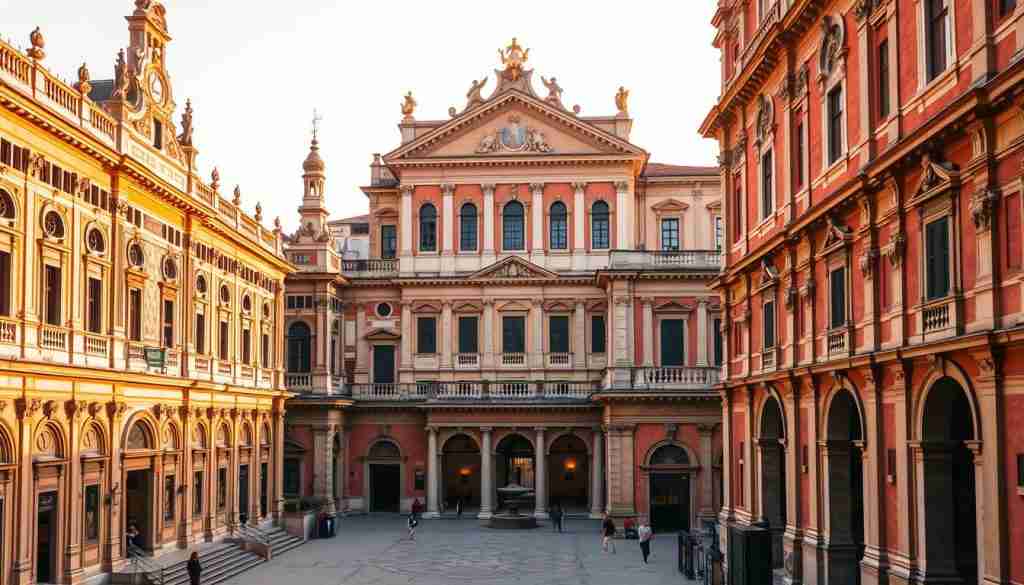
The National Archaeological Museum provides essential context. It houses artifacts from regional excavations, spanning Roman, Neolithic, and Bronze ages.
National Archaeological Museum Insights
Its most extraordinary treasure is the Lovers of Valdaro. These 6,000-year-old skeletons were discovered in an eternal embrace.
This find is a profoundly moving testament to human emotion. The museum is housed in a remodeled market hall. All items feature comprehensive English labeling.
A combined ticket with the Ducal Palace allows for efficient exploration. It connects ancient history with later artistic achievements.
Teatro Bibiena: A Baroque Wonder
Teatro Bibiena is an 18th-century architectural masterpiece. Designed by Antonio Galli Bibiena, it opened in 1769.
The intimate theater features a unique bell-shaped interior. It is crafted primarily from wood, creating exceptional acoustics.
Wolfgang Amadeus Mozart performed here in 1770 at just 13 years old. This adds to the city‘s impressive artistic associations.
Visitors can attend live performances or tour the interior. The compact scale creates a special connection between audience and performers.
| Cultural Venue | Era Focus | Key Highlight | Visitor Tip |
|---|---|---|---|
| National Archaeological Museum | Prehistoric to Roman | Lovers of Valdaro skeletons | Get a combined ticket with Palazzo Ducale |
| Teatro Bibiena | 18th-Century Baroque | Mozart’s 1770 performance | Check schedule for live concerts |
These institutions are essential for understanding Mantua’s full cultural identity. They beautifully complement the dominant Renaissance narrative.
Savoring Local Cuisine and Historic Dining Spots
Local Mantuan cuisine tells stories of family traditions and regional ingredients passed through generations. The city‘s 2017 designation as European Capital of Gastronomy confirms its exceptional food culture. This honor reflects how dining here represents more than sustenance—it’s cultural immersion.
Indulge in Tortelli di Zucca and Torta Elvezia
Autumn visitors discover Mantua’s signature pumpkin-stuffed pasta, Tortelli di Zucca. These delicate parcels balance sweet squash filling with savory butter sauce. They represent Lombardy’s sophisticated flavor profiles.
Additional traditional dishes showcase local resources. Risotto Alla Pilota uses rice from surrounding fields. Salame Mantovano offers slightly sweet charcuterie. Bigoli con le Sardelle features simple, bold flavors.
Don’t miss Mantuan mostarda, a unique condiment of candied fruit in mustard syrup. It perfectly accompanies meats and cheeses. For dessert, Torta Elvezia provides an elegant conclusion with almond paste and meringue layers.
Excellent dining places range from Michelin Guide restaurants to traditional osterias. Il Cigno Trattoria dei Martini offers refined local dishes. Osteria della Fragoletta preserves authentic family recipes.
Specialty spots like Gelateria Loggetta serve artisanal gelato. Casa del Pane bakery sells fresh Torta Elvezia. These establishments ensure visitors experience Mantua’s food culture beyond formal meals.
Conclusion
For discerning travelers seeking authentic Italian experiences, Mantua delivers cultural immersion beyond compare. This UNESCO World Heritage destination combines Renaissance splendor with genuine local charm.
Visitors can explore remarkable attractions within just one day or extend their stay across several days. From the magnificent Ducal Palace to peaceful lakeside views, the city offers concentrated cultural riches.
Mantua’s accessibility makes it an ideal addition to northern Italy itineraries. Travelers can easily reach this historic town by train or car from major cities like Venice and Bologna.
The compact scale allows for both structured sightseeing and spontaneous discovery. This way of exploring reveals hidden gems and creates lasting memories.
Our recommendation: allocate sufficient time to fully appreciate Mantua’s layered history and artistic legacy. This remarkable heritage site promises an unforgettable travel experience that will likely inspire return visits.


